

The Pelican — Exploring the Cauca Valley: Stories From Our Tour in Colombia!
Updated: Aug 2
By Diane Wong-Kone
Colombia is the country that boasts the greatest bird diversity, and no wonder. Spanning from the Pacific Ocean to the Caribbean, where the Andes split into three mountain ranges, with the Amazon Basin to the south, the tropical savannas to the east, and the unique Santa Marta Mountains in the northeast, this country’s habitats are as diverse as its bird life. It would be impossible to see all the birds of Colombia on one small trip, but in February of this year, a small group from Northwest Nevada Bird Alliance joined Flyway Birding Tours to explore the Cauca Valley, an area with intact patches of cloud forest, bordering the Cauca River valley.
“No good roads lead to good birds,” says our leader, Mario Cordoba. That is because many birds are common in the cities we build around the world, but increasingly rare birds tied to non-developed habitats are found in remote areas away from towns. To catch a glimpse of the colors and biodiversity of the bird world, we need to explore places with very different habitats, flora, and fauna. The interior cloud forests of Colombia may be among the most endangered habitats on our planet, and they host unique birds found nowhere else in the world. Increasing forest fragmentation threatens the survival of many species, but hope sprouts as people have realized how special bird diversity is in this part of the world.
Ecotourism is one of the drivers that boost the economy as important bird habitats are preserved. We met many hopeful people, guides, landowners, farmers, and conservationists with a passion to preserve the lands, for the birds, and for us. The lives of birds and people are intertwined, because birds’ survival and that of the special habitats where they thrive are tied to our well-being, too.

Doña Dora
Before our tour began, our AmeriCorps member, Julie, joked that the Andean Cock-of-the-Rock was not an A.I. bird, but it’s easy to think it might be. With bright red feathers that cover its head and bill, red-orange eyes, orange feet, a body shape that resembles a stumpy parrot, and white wing feathers over a black tail that makes it look like it’s dressed for a formal, this bird seems unreal. Its calls, sounding like a cross between a distant motorcycle and an electric bandsaw, make it seem out of this world. The males display as a group, bowing their heads and hopping between perches for a chance to breed with a plainer-looking, but still extraordinary female, who will nest on a steep rock cliff, a nesting habit that gives the bird its name.
The story of Doña Dora is as extraordinary as the bird itself. Doña Dora, famed for her homemade empanadas, was displaced from her home during a period of conflict, but then she opened a restaurant in the forest near Cali. She cooked for the workers who used the local trail and began feeding the birds found in the nearby forest. Our guides, Mario and Ozzy, explained that one day, someone recognized the sounds of the Cock-of-the-Rock — a hard-to-find bird. Because these birds nest on steep cliffs, no one knew the location. So, one day, Doña Dora’s son took an excursion and hiked or rappelled down the steep mountain slope. He was gone for three days, but he succeeded in finding the lek site, where males gather in a grand courtship display for the female birds. The family then carved the narrow trail that winds down, down, and farther down, into the depths of the clouds and forest.
As our group walked down in the dark, hugging the edges of the rock before dawn, shapes began to form as trees, rocks, and lighter spaces of open air through the mist. Then, seemingly out of nowhere, the birds appeared. Like seeing your neighbor across the fence of a yard, the birds were close. They were so close, you could see the color of their eyes (red with a yellow ring) without binoculars, a trait that distinguishes the birds on the Pacific slope of the Cordillera Occidental in Colombia from Cocks-of-the-Rock found elsewhere. Thanks to her passion for saving the forest, today, Doña Dora and her family cater to visitors from afar who travel the world to see the lek and many other specialty forest birds.

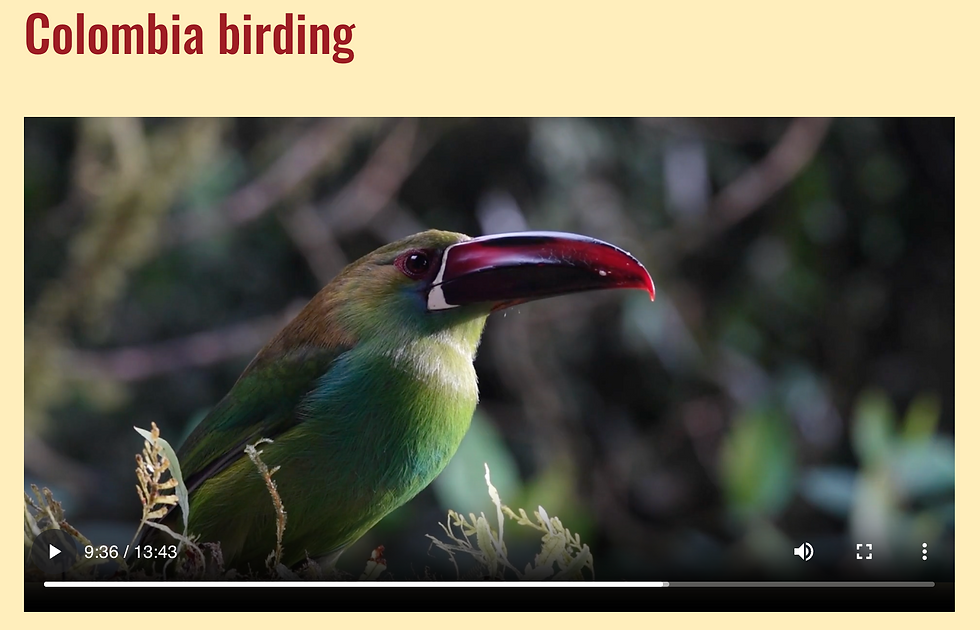
The Bird Feeders
The Birder’s Show on YouTube dubbed the feeding stations in Colombia as the “best backyard birding on Earth.” With birds representing all the colors of the rainbow, they may be right. The secret is red grapes. Many feeders in the tropics use bananas and papayas, but in Colombia, the most spectacular birds look for grapes. For a Mountain Toucan, Mountain Tanager, or a Toucan Barbet, red grapes are irresistible. The bird feeding stations are set up especially to help the visiting photographer capture the birds in action. Hummingbirds dazzle with the frenzied zips to and fro, but the feeding station managers spray flowers with sugar water, and they plant nectar-flowering plants at the stations to give photographers a chance to capture the moment when a hummingbird visits a beautiful flower. Likewise, fruit feeding stations are set up with special mossy perches where the birds alight, offering multiple opportunities to photograph them from many angles. Whether you are a photographer or someone like me, seeing some of these birds for the first time and learning to identify them, the perches and photographs offer spectacular learning and viewing opportunities.


Years of patience have led to the development of special antpitta feeding stations, where you can see the birds that look like “eggs on legs.” Some very special antpitta feeding stations we visited included stations at Hacienda el Bosque and Rio Blanco. New species of these secretive forest birds are still being discovered. At Doña Dora’s place, murals depict some of the birds found in the surrounding forest, and one antpitta, nicknamed “Salsita” for its dance, has yet to be given a species name.
The antpitta feeding stations in Colombia showcase the intersection between the birds and the humans who have patiently spent years at a feeding station, hoping to coax a bird out of a thicket for a brief glimpse. Our tour had a chance to see some very special bird feeding stations at most of the places we visited: Doña Dora’s, La Florida, Araucana Lodge, the preserve at Rio Blanco, Hacienda el Bosque, and Termales del Ruiz. Although some birds frequented the feeders at multiple stops, each new feeding station had a new bird to see! One of our participants, Robin Holabird, interviewed some of our local guides to learn more about the country, the birds, and the people.
The Paramo
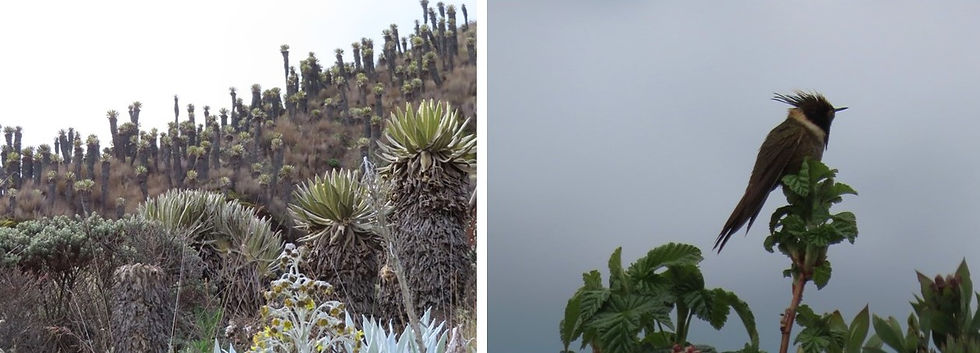
Like visits to lowland deserts, visits to the highest elevations are like visiting a strange new world. Unique plants shaped a little like our Joshua trees but more closely related to daisies and composite flowers, Frailejones (Espeletia spp.), dot the paramo landscape in Colombia. These and other plants of the paramo are adapted to soak in the mist from the descending clouds, releasing water to feed the mountain streams and valleys below. Looming in the distance are even higher peaks, snow-covered and sometimes steaming from the volcanic vents that formed the mountains in this part of the Andes. The cold, high-elevation climate is not a place where birds of the cloud forests below could survive.
We stood and waited, scanning this strange and beautiful landscape. Looking out at the Andean shrubland is not that different from staring at the sagebrush sea. Finding birds here means watching for a quick movement, hoping to catch a glimpse before the bird disappears into the thicket of branches. Even in this harsh environment above 13,000 feet, a hummingbird thrives. Who can imagine that a small bird like a hummingbird can live at one of the highest elevations on Earth? Yet, there it was. A quick movement, over by the red flowers — a tan bird. It turned with a flash of royal purple. This was the Buffy Helmetcrest, an endemic bird that birders seek. It gave us a show, though photographing it was challenging.
Familiar Worlds, Yet New.
Far from the paramo and down in the valley, oxbows are a part of the natural cycle of rivers. Oxbow Park, here in Reno, is situated where the Truckee River meandered and left a remnant bend of water that was cut off from the main channel. Today, the oxbow pond that remains forms a quiet area of water and marsh where birds that don’t frequent the faster-flowing stream can reside. It is a spot to discover new birds, some secretive, some rather loud, all adapted to the quiet backwaters and tall reeds. Oxbows are important features of the river ecosystem that have become rare as people have developed rivers for farming and urban development. This is a common story, here in Nevada and in the Cauca Valley.
North of Cali, there is an old oxbow the locals call the Madre Vieja, or “Old Mother,” a cutoff meander where the river used to flow. Preservation of this old oxbow and the surrounding forest, surrounded by agricultural fields of sugarcane, is a place to see a great diversity and number of birds. Just like in Nevada, quiet backwater areas provide important habitat for birds. At Sonso Lagoon, you might see some birds that seem familiar. Osprey, Spotted Sandpiper, and Snowy Egret can be found here.
Look closely, though — that bird that looks like a Great Blue Heron is really a Cocoi Heron, with more white in its plumage. The small streaky heron wading in the wetland may be a Black-crowned Night-Heron, but it could also be a Striated Heron. Blackbirds, common in Nevada, are seemingly replaced by anis, and owls by potoos, at Sonso Lagoon. Unique birds, like the Grayish Piculet, the smallest woodpecker I have seen, Apical Flycatcher, Comb Duck, and Spectacled Parrotlet can be discovered with a little patience, knowledge of the habitats, and sometimes with the help of a good guide!

Some Very Special Sightings
“Oh.” It was more of a grunt than a word, but if you heard Ozzy, our bird guide, making this quiet noise, it was time to pay attention. Every time he did this, something special was about to be seen. Some birds and other animals do not readily come to bird feeders. One of our first such birds was a White-tipped Sicklebill, whose strongly curved bill is adapted for feeding on heliconia flowers. At Sonso Lagoon, it was the splashy family of capybaras and Pinnated Bittern that made us all look.
One of our most special sightings, though, was at Rio Blanco. This higher-elevation preserve is near the town of Manizales, and we had a special private guide to show us the trails and feeding stations in this preserve. Sure enough, our group was on the trail, and there was that tell-tale, “Oh.” Looking up, there was a big bird, shaped like a turkey, in the tree. It was a guan, but not just any guan. This was a Cauca Guan, with a red throat patch, red feet, and cinnamon-colored wings. The Cauca Guan is a very rare and endangered bird, and its distribution map shows pinpoint dots in a smattering of spots in a small part of Colombia. Our guide, Ozzy, and our group were the first group of birders to see this bird on this day. What made our sighting special was that it was the very first time a Cauca Guan had been documented inside the Rio Blanco preserve!
On another day, we 4-wheeled it on one of the “chicken bus” dirt roads. The chicken bus in Colombia is a brightly colored bus that travels the back roads in the Andes, often connecting rural ranches and villages. Now a little familiar with the Cauca Guan, our group began counting birds in the trees along the road. Ozzy’s previous record for a Cauca Guan count along this road was around 24 guans. On this day, our group spotted 31! This was a positive sign that maybe this small group of endangered birds may be starting to increase in numbers and range!

Elated with seeing all the guans, we stopped for breakfast, and then again, we heard, “Oh.” We froze. Just on the edge of the forest in front of our table, where we were enjoying coffee and arepas, the leaves were wiggling. Or maybe it was a snout? The gardener of the forest was there, a mountain tapir! It was very close, and everyone in our group had some great looks at the smallest, and possibly the most endangered of four tapir species in the world. Tapirs are important herbivores that spread seeds of forest plants in their dung, thereby facilitating forest regeneration. The mountain tapir is an important seed disperser of Colombia’s national tree, the wax palm, another endangered species, which may still be seen on slopes of the Andes.
Giving Raptors a Second Chance
At one point, Mark, one of our tour members, remarked that we hadn’t seen many raptors. Raptors, unfortunately, are not doing well in the tropics due to habitat loss, habitat fragmentation, and active hunting driven by conflicts between raptors and poultry farms. In Colombia, one group of avid wildlife rehabilitators employs the art of falconry to return endangered and threatened eagles, hawks, and falcons back to the wild. When birds are injured or orphaned, they can be rehabilitated in captivity for a time, but to be released successfully back to the wild, they need to hunt. Using gloves, hoods, food, and falconry techniques, the rehabilitators at the Centro de Rehabilitación de Aves Rapaces San Isidro, or CRARSI, have a program that either teaches birds to hunt or takes them through the steps needed to regain flight and the ability to hunt live prey.
CRARSI is a conservation program that our tour helped support through donations. In talking to the CRARSI Director, Alex Ospina, I learned that funding for raptor rehabilitation was waning, and this group — the only raptor rehabilitation center in Colombia — is actively seeking new funding sources to continue its operations. When you see the power behind the eyes of a Black-and-Chestnut Eagle, you understand that this is a bird that is meant to be free and soaring the skies. The folks at CRARSI are doing a great service, giving a chance at life for some very special birds indeed.

Where Will We Go Next?
Diversity is something to be celebrated, and birders are a group that delights in the various colors, patterns, voices and behaviors of the bird world. As we see more of the diverse habitats and the dazzling display of birds, we begin to understand a little more of our world. In a world far away from my home, a Crested Ant Tanager flits through the shadows of trees unfamiliar to me, but it makes me happy to know there is a wide world of beauty to explore and be amazed at.
If you get a chance to visit the Andes, the cloud forests, the valleys, and even more of the places beyond our Cauca Valley tour, take the opportunity. Traveling with a good bird guide will reveal new birds and secret places not seen by many travelers. Flyway Birding Tours and our chapter will be continuing our exploration of the Andes with a visit to world-renowned birding preserves in northern Ecuador in the Fall of 2026! Grab your binocs and go! It’s a birding adventure you don’t want to miss.
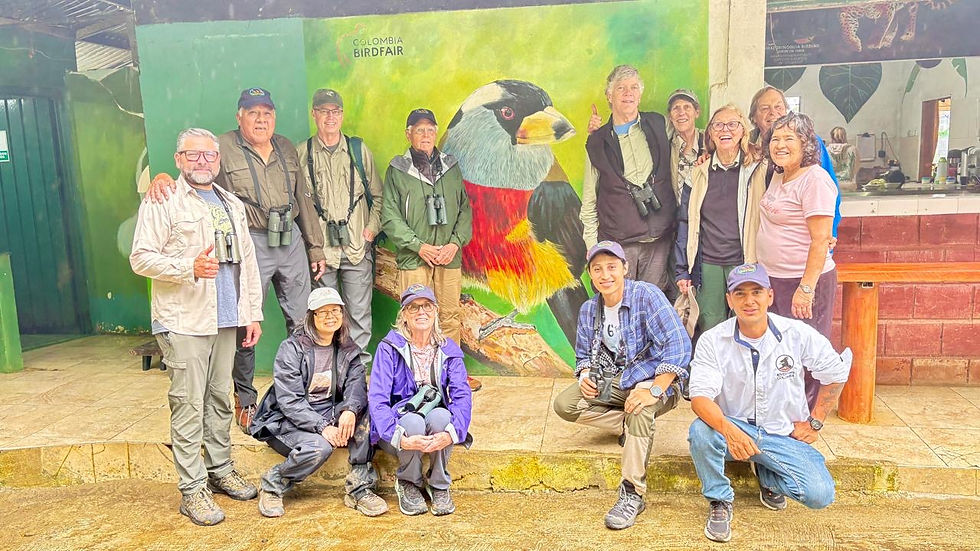
Birds connect us! Making new friends and exploring new trails is what it’s all about! Photo of our group at Doña Dora’s restaurant. Left to right, standing: Mario, Ron, Brent, Mark, Fred, Robin, Barbara, Chad, Dora. Sitting: Diane, Teresa, Oswaldo (Ozzy), and Mateo.
More to explore:
Full eBird Report (331 species, more bird photos) https://ebird.org/tripreport/473107
The Best Backyard Birding on Earth! https://www.youtube.com/watch?v=qQhM_SNaxPM&t=6s
Preview of Ecuador: https://www.youtube.com/watch?v=F98Pw2DJOPA


Comments