

The Pelican — The World of Birds at Claridge Pointe
Updated: Jul 19
Elevation: 5,181 ft.
Article and photographs by Robbyn L. Tolles, a 30-Year Resident
I have been living at Claridge Pointe in the Raleigh Heights area for nearly 30 years. This mini bird memoir describes some of my sightings and changes in visitations from our feathered friends across that time span. I have cataloged over 40 different species of birds in my immediate environment.
When we first moved to our location in the North Valleys of Reno in 1996, North Virginia Street above Panther Valley was a little-used backcountry road. Pelotons of cyclists rode by on the weekends. There was a spring and a pond in the center of our community property that fed the watershed of Evans Creek. The little pond was visited by Mallards, Red-winged Blackbirds, and even the occasional Great Blue Heron. In the summertime, Nighthawks and swallows swooped around the pond as well. Above the patch of desert to our east, I watched Golden Eagles, Northern Harriers, Turkey Vultures and flocks of Canada Geese. I regularly heard the songs of Red-winged Blackbirds and Western Meadowlarks at the small wetland there.

Black-billed Magpies lived in the willows and Russian olive trees in the wash. They were constant visitors to our suet feeders in the winter. We would see Killdeer calling while running along the edge of the road. Early on, Bullock’s Orioles would enjoy singing from the top of our pear tree.
One day, not long after we moved to this location, an American Kestrel chowed down on two field mice right outside our window. We had a lot of mice at that time so we were happy to have him controlling the population. About twenty years later, another kestrel helped himself to a female House Finch on the wire above our house. Luckily, there are lots of finches around.

Among the birds that have remained in residence across time have been the House Sparrows, House Finches, and the Lesser Goldfinches. We regularly see Downy Woodpeckers and Northern Red-shafted Flickers at our feeders. California Scrub Jays, who particularly enjoy sunflower seeds, were here from the start as were the Mourning Doves who like to hang out below the thistle feeder. In the fall, White-crowned Sparrows arrive as a harbinger of winter; when the weather warms up, they disappear for more northerly climates. Occasionally, Song Sparrows will join the flocks of small birds. Solitary Red-tailed Hawks and Common Ravens, usually in pairs, have remained in the neighborhood. Starlings now seem to show up in smaller flocks that those of thirty years ago. Robins have been here since the housing areas were developed. Some years huge flocks of them appear in early spring. They often nest in the trees by my house. I always enjoy watching bevies of California Quail scurrying around with their fluffy little chicks trailing in a line behind them.
Great-horned Owls are present in Raleigh Heights which adjoins our community. They like to call at dusk. I was excited to learn that you can tell the females (higher call) from the males (lower call) by the pitch of their voice.
Now the neighborhood is very different. While we haven’t seen a lot of construction here, just over the hill, work has been in progress on Route 395 for several years now, forcing traffic up North Virginia Street. We are not a quiet country road anymore. The pond isn’t filled often enough for birds to nest there and only the occasional pair of Mallards shows up for a brief stop.

The Mountain Chickadees were not seen until the community’s pine trees matured. Up until this very warm winter of 2025-2026, there were many of them nearby, but I think that they did not migrate down the mountains this year. Similarly, the Ruby-crowned Kinglets, Yellow-rumped Warblers, Oregon Juncos, Bushtits, and the Red-breasted Nuthatches did not appear at our feeders.
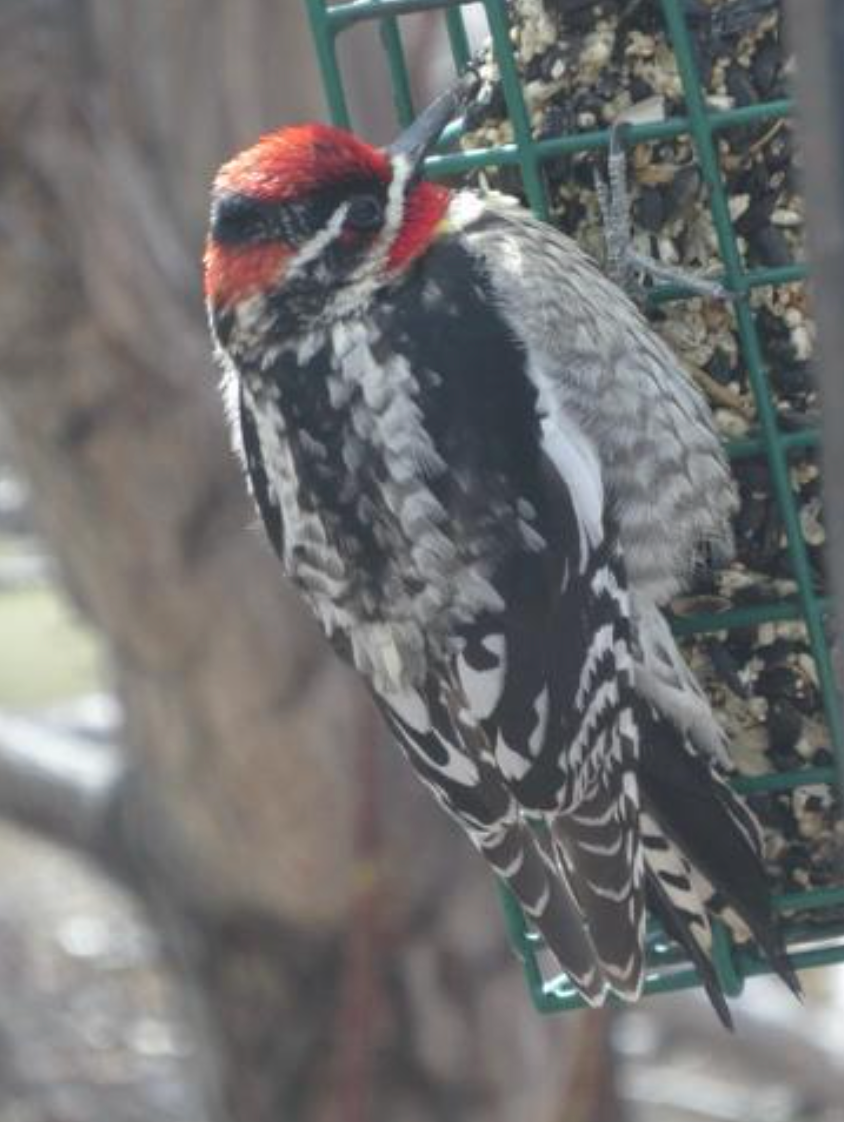
So what are the new birds in my area since I first moved here? Approximately ten years ago, I spotted my first Eurasian Collared Dove. Now they are abundant in this area. Cooper’s Hawks are now regular residents. They cause me to place bird baths in more protected areas. Northern Mockingbirds, Spotted Towhees, and Black-headed Grosbeaks now appear every year. Mockingbirds hang out most of the year while the towhees and grosbeaks come through in the spring. My newest bird is the Red-naped Woodpecker.
My story is not so much about loss and gain of bird species in my area, but rather of change. I still see Harrier Hawks at Swan Lake, just up the road. The magpies were put out of their habitat when the city decided to cut down the cluster of trees where they resided. Now there seem to be fewer of them and they are dispersed down the valley of Evans Creek.
Since birds have the ability to fly, they can move to other places when conditions do not suit them. Weather conditions impact the presence of many bird species as well. When it’s wet or dry or snowy with colder or warmer temperatures birds move around. These variables make bird watching interesting and fun.
In the first few years that I have lived at Claridge Pointe, I often heard the lovely song of the Western Meadowlark. Just this March as I looked out my window, I saw a flash of yellow in the Amur Maple. Upon closer observation, I recognized it as the meadowlark. A few days later, “Birding Nevada” members spotted them in Washoe Valley. I hadn’t seen one for years. Back on October 22, 2002, I wrote a Haiku poem about them.
Six forty-five in the morning
Amidst the rush of traffic
A meadowlark sings.
It’s good to have them back.
April 2026


Hi Robbyn, I love the poem you added to your article! I also very much love your observations of how your environment is changing over the years. I am one of the people who recently moved into a new subdivision in the North Valleys. In the first year of me living here, it was a rather sad and sterile environment, with hardly any birds around. Now, as the sidewalk trees grow and the landscaping plants are more established, I realize with joy that more and more creatures find their way into my neighborhood. Every time it happens, it's exciting to add a new sighting to my "log"! Thank you for sharing your observations! By the way, I often walk my…